
Renewal as Tenacity
What is renewable in our everyday life?

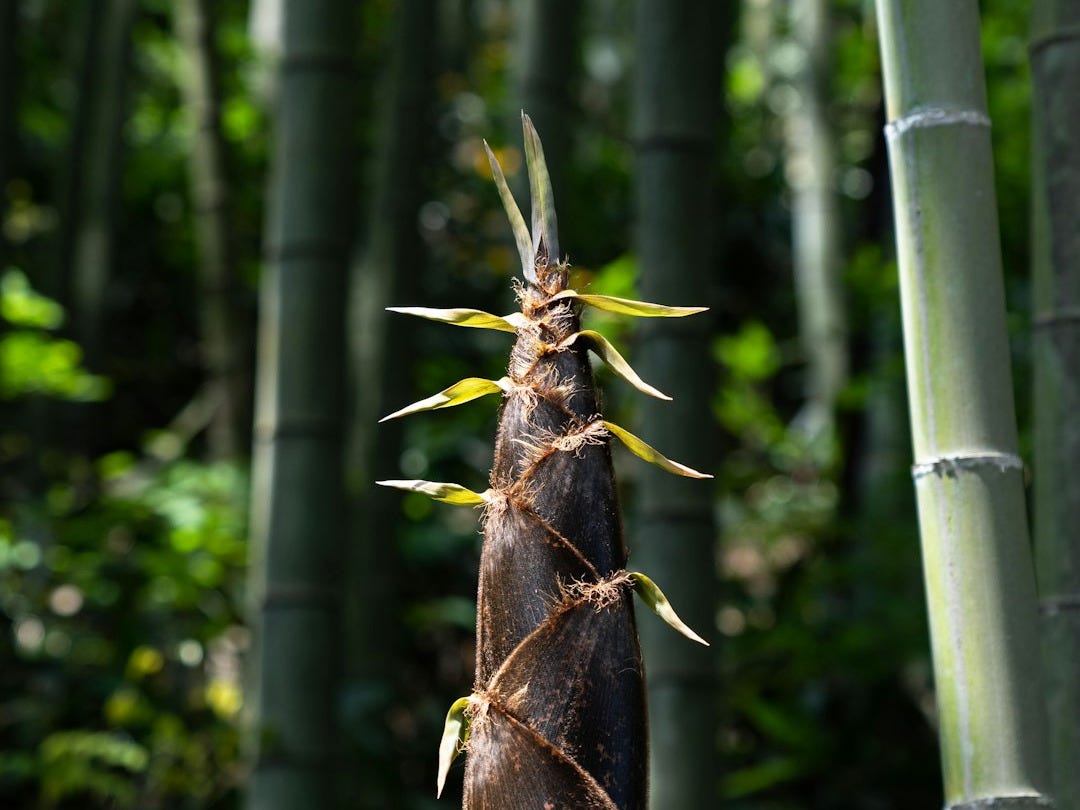
I was sitting in my yard taking care of a very cute puppy who had so much energy that she could not stop moving. Even after a walk, she wanted to sniff everything, pee on things and gallop around chewing on sticks. While watching her, I noticed where the bamboo in my yard has crept carefully towards the edge of my patio, pushing it’s way up amid pavers with it’s piercing almost conical new tendrils.
The bamboo in my yard is tenacious, much like the puppy. So much energy, so much capacity to push through, to continue, to press on even when there are literal stones to push through.
We often think of renewable energy being fully about solar panels, geothermal, hydro, biomass, and wind turbines. These are the renewable resources that we have named as clean, green and which harness energy and convert them to energy into other forms at scale. But it is also frankly, a successful PR campaign to think these are the only renewable resources we have.
It is limiting to focus only on converting wind, hydro and solar energy to electricity when talking about what is renewable. It prevents us from seeing the systems, ideas, beliefs and capacities that renew around us every day, week, year and season.
There are so many more systems that renew:
Our blood pumps, our lungs breathe, our eyelids flicker.
Seeds spread through wind, animals, digestive tracts.
Water cycles through rain, rivers, oceans.
Animals keep mating and having babies.
Our earth, natural world and the systems that exist within it are remarkably tenacious. The world spins - the sun shines, the tides move. we have renewable resources because of the way that life is tenacious.
We are a part of the natural world and if we choose, there are renewable aspects of ourselves. Not just our blood and our skin, but also in our ideas, our way of thinking, our choices in the world, our way of being.
For example, the poem Call it A Day by David Roderick reminds us about the renewability of awe. Part of the poem:
“Children have led me to burrs,
mushrooms, maggots, prickers, and scat.
Once to a hummingbird nest.
Once to a Jerusalem cricket clapped in a cup.
Awe, so much awe
I’d argue that every day is a weed
in a jar on our counter,
that this acorn in Olivia’s hand
contains twenty million future oaks, potentially.”
I appreciate the idea that the things we might consider detritus, a hummingbird nest, scat, prickers, or a weed - they all possess something that we can look at more closely, it’s an everyday part of our life, but it can give us a sense of the future, of something bigger than ourselves.
Roderick is saying that nature is tenacious in it’s ability to produce awe. If we listen, if we let children show us what amazes them, if we are willing, we can find awe. Which is renewable if we let it be. I wonder if we can find renewable hope or beauty or growth as well. Those things also seem to be all over the place too.
This post comes from my Everyday Flourishing workshops—monthly spaces to pause, reflect, and share ideas about flourishing in daily life by thinking about permaculture principles. You’re invited to join in!
Next up: October 13 at noon PST — Use and Value Diversity.