
Sunshine in the Winter
On rereading beloved children's books, finding abundance, putting it up the hill and stacking delights


There is a particular pleasure and ease to children’s books. They ask for you to look at them closely, to hear the rhythm of what they say. But they also are OK with you needing to read them about 10 times before you get your head around the story. They’re simple, but not easy. Beautiful but not intimidatingly so. They’re open to our interpretation and what we bring to them.
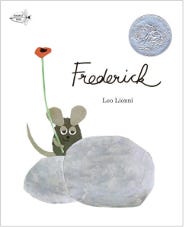
Many of you may have read the story of Frederick an allegory by Leo Lionni. I’m going to share a short synopsis. of the story – though if you haven’t read it, please do take the time to do so. The pictures are well worth it and my version will not do it justice.
Here's the story: The field mice who live in a wall gather all kinds of things to store for the winter: corn, nuts and wheat, but not Frederic. While they work to put away the food for their winter tells them that he gathers the rays of the sun, colors and words. The winter comes and the food had been consumed and the stories have been told. They are cold, lonely, and hungry. It’s then when Frederic shares with them the way that the rays of the sun felt, the colors of the summertime and the stories and words he had collected during the summertime. Frederic's memories of the sunshine, color and stories makes it possible for them to get through the hard winter.
This story reminds us that art and poetry matters, that we can collect things that are not just foodstuff and that we can ask one another to help us keep warm when things are challenging. It reminds us that in the wintertime, we need a very particular kind of nourishment that doesn’t come from food.
Things are challenging right now - at least for me they are. There is illness in my family, the federal funding cuts are hitting people and institutions I care about, there are wars and every day seems to bring more challenge to the front page of our newspapers.
Plus it’s the winter, which is a time when I don’t really tend to think I have all that much in abundance, except for cold, grey, starkness. When the world feels hard, and I get crabby at small things that bring up grief, or remind me of my rage, or that make me feel deep sadness. The winter feels really bare - stark. It can be hard to feel like you have a lot of anything.
It’s times like these when I need reminders like this one from poet Amy Schmidt that when we believe that we do not have enough, citrus peel makes the room vibrant.
Much like the little mouse in the storybook Frederic. He asks us to remember what the sun feels like. To remember stepping into it, perhaps dozing in the sun’s rays like a cat in a sunbeam. To think of colors we especially like: the deepness of a rose, the shocking vibrant green of a new leaf, the oranges and yellows of a beautiful sunset. To remind ourselves that the colors still exist in our minds. To think about the stories we love, the words we treasure. To sit with what is said and to remember great words that poets have given us.
When thinking about how to store the kinds of things that support me, I've had a few thoughts.
Abundance
First is to consider abundance, because we live in a modern society that has so much in it that is abundant. And of course, the natural world has so much abundance too. When we know we have enough, I find things easier.
I often will turn to artists when thinking about abundance I se them getting super creative with what we have a lot of - instead of thinking of it as a problem. We aren’t coming from a place of lacking when we look at what we have an excess of.
A few examples that I like:
Junk Journaling asks, what can we make that's creative from what we often think of as junk? What if we saw our trash as something to create with? What do I see as a nuisance but which might end up being a treasure?
Scrap stores are places where there are buckets of flip tabs, boxes and boxes of altoid tins, or the lids of sour cream tubs, or an entire tub of broken crayons. There is creativity in this - what might we do with what we have a lot of?
I get inspired by folks who make baskets from invasive species. How might we take the things we have a lot of, that we might not like and turn it into something that is beautiful, useful, even beneficial?
Putting it up the hill
One of the challenges in the renewable energy industry is that wind turbines are often quite steadily able to produce energy at night when the wind is strong, which is not a time when most folks need to turn their lights on and off.
So there are ideas about how to create storage and one of them is called pumped hydro storage. You take the energy generated by wind and use it to pump water up a hill. When the wind dies down, you let the water flow downhill and generate electricity from gravity pulling the water downhill.
If we think about this in terms of our personal energy, what might we “put up the hill” so that when life is hard, we can easily draw on what we have to refuel us? What is easy to store for ourselves, but will recharge us when we let gravity return it to us? How might I think about what to do for myself when I'm in a good mood, or when the sun is shining that would support me when things are more challenging?
I know someone who goes to dog parks because watching dogs be happy is endlessly energizing for her. She doesn’t have her own dog, but likes to go watch dogs be happy. Just watching them romp renews her.
There’s a story about Margaret Mead, the great anthropologist who got quite a lot of hate mail. The story goes that she used to save the mail and when she was having a day where it felt hard to get things done, she’d pull out a letter and read it. It would work her up so much that she’d jump right back into her projects. Perhaps anger can be a source of motivation.
I have these little crystals in my window which light up and give me little rainbows on my wall, it makes me really happy and requires nothing. At odd times there will be rainbows. This could also be wind chimes, art, a soothing color, fuzzy blankets
A cup of tea takes so little effort and literally warms me from the inside. It’s one of my favorite ways to recharge.
Jams and preserves are basically bottled up summertime. When you next taste a bit of jam or a jar of pickles, can you taste the fruit? The vegetable? What does this offer you as a reminder? How is it nourishing you?
Stacking Delights
Another approach is from Ross Gay whose “The Book of Delights” (which in itself a delightful book). His project is small essays on what delights him in a given day. In the book he writes:
“I’m about five months into this delight project. Naturally as these delights accumulate, as they stack up, I begin to recognize patterns, both in the ways the delights operate, unfold, amble or stumble or babble toward their knowledge (or confusion), and in the way I have come to relate to their making… So today I’m recalling the utility, the need, of my own essayettes to emerge from such dailiness and in that way to be a practice of witnessing one’s delight, of being in and with one’s delight, daily, which actually requires vigilance. It also requires faith that the delight will be with you daily, that you needn't hoard it. No scarcity of delight. And in that spirit, I am going to empty the docket, clean the slate of delights I have squirreled away in various notebooks, usually in bulleted but scrawly lists, some of which I have in a stack on my lap. My lap is full of delights. And as strange as it sounds, clearing them away is itself a delight.”
This makes me think that we sometimes put away things that energize us believing that we must hoard it, or that it is not something that actually IS renewable. Gay is hints at the idea that we must have some faith in the renewability of these things that are actually renewable. He is saying in a sense that “clearing the dockets of delight” is in itself be a delight. Perhaps emotional states like delight, joy, love, pleasure, are renewable, but we need not save them, in fact by expressing them we are able to access them even more. Paradoxically, we store emotional energy when we use the energy.
What are the stacks of delight you have around you? What do you already know brings you joy that you keep to the side? Knowledge might be more effective when shared and it might be more delightful to unstack it instead of keeping it for yourself.
There are things inside my house that I already know delight me. Where is that book whose pictures I used to linger on as a child? What might it feel like to spend time with the color of my living room, knowing that I really love and appreciate the color of it, which I spent a long time picking out? What about pictures that I adore of family members, or poetry that I love. Or the tea I save for “the right day”
I remember getting a pair of pearl earrings once from a dear family friend and I said “I don’t know if I have the right time to wear these” and she responded, wear them today. You just need to wear them when you want to wear them, not when it’s the right time to enjoy them.
If you'd like to share, I'd be interested in learning about your abundance, what is an energetic orange peel in your life? What is a renewable uphill energy source? What joys have you stacked? What are the things that are easily able to store what enlivens you?
This piece came from my monthly workshops called Everyday Flourishing: https://www.everydayflourishing.org/. Our next workshop will be at noon on Monday, March 10th and you'd be welcome to join us.